Level term life insurance is designed to give your loved ones a fixed, tax-free cash payout if you pass away during the policy's lifespan. The magic is in its consistency: the amount of cover and your monthly payments are set in stone from the very beginning. This offers unwavering, predictable financial protection when your family would need it most.
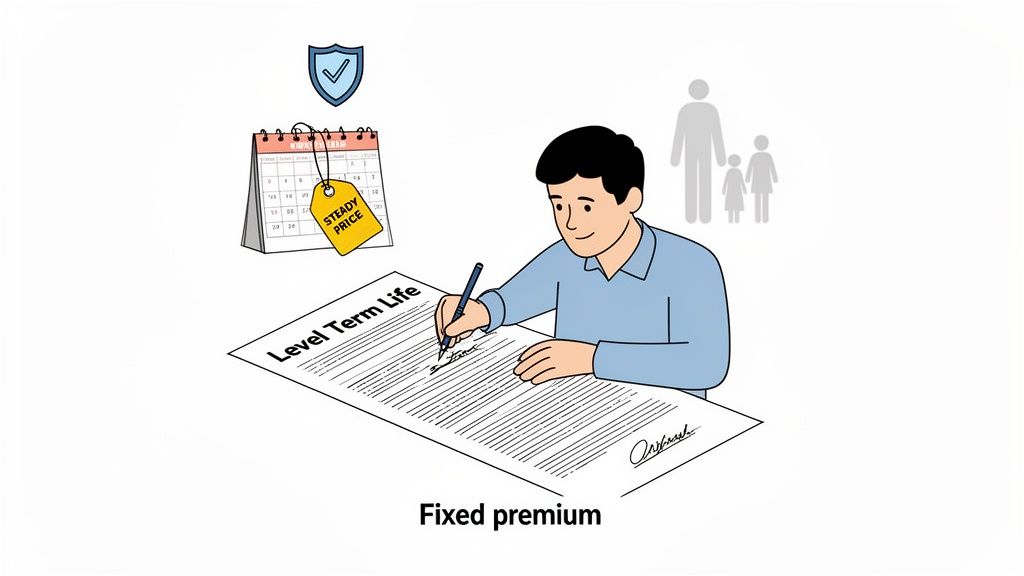
Think of it like fixing your mortgage rate, but for your family's financial security. You agree on a set monthly payment (the premium) for a specific number of years (the term). In exchange, the insurer promises to pay out a large, pre-agreed sum of money to your family if you're no longer around during that time.
It’s this simple, reliable promise that makes it one of the most popular types of protection here in the UK.
At its heart, the policy is a straightforward agreement between you and the insurance company. Let’s quickly break down the key parts you'll come across.
To give you a clearer picture, here’s a quick summary of how the main features work.
| Feature | How It Works | Why It Matters |
|---|---|---|
| Fixed Premiums | Your monthly payment is locked in on day one and never changes for the entire term. | Makes budgeting simple. You don't have to worry about costs rising as you get older. |
| Fix Sum Assured | The cash payout amount is fixed. It's the same whether a claim is made in year 1 or year 24. | Guarantees a specific sum for your family, perfect for covering a mortgage or other large debts. |
| Fixed Term | You choose how long the cover lasts, often from 5 to 40 years. | Lets you align the policy with key life stages, like when your kids are dependents or you're paying off your home. |
This table shows the fundamental building blocks of the policy, making it a powerful and easy-to-understand tool for financial planning.
The core benefit is predictability. In a world full of financial uncertainty, knowing your life cover payment and the final payout will remain constant provides a powerful sense of security for your family's future.
This stability is why so many people make it a cornerstone of their financial plans. In fact, 2024 data shows that the average monthly premium for a level term policy was just £35.52 for an impressive average cover amount of £133,144. It really highlights how accessible this level of protection can be.
With quotes from leading UK insurers starting from as little as £5 per month, it’s a vital safety net for countless households. You can explore more about average UK life insurance costs to see exactly how these figures stack up.
It’s one thing to talk about the theory, but seeing how a policy works day-to-day is what really brings it to life. A level term life insurance policy is reassuringly straightforward, and its journey can be broken down into three simple stages.
It all starts with your application. This is where the insurer gets to know you—your health, your lifestyle, and what you’re looking to protect. This process, known in the industry as underwriting, is how they calculate your fixed monthly premium based on the level of risk.
A typical level term policy is designed for predictability, offering you security and peace of mind from day one. Let's walk through the journey, from filling out the form to the moment your family might need it.
Let's look at Sarah and Tom, a couple who’ve just taken on a 25-year mortgage for their first home. To make sure the mortgage would be cleared if one of them died, they take out a level term policy.
If a claim is made in year three or year twenty-three, it makes no difference. Their family would receive the full £250,000. That fixed payout guarantees the mortgage debt is wiped out, giving them crucial financial breathing room at an incredibly difficult time. To explore this type of protection further, our guide to term life insurance has more great insights.
This practical example really highlights the power of a level term policy. It's not just some abstract financial product; it's a solid plan built to protect a massive life commitment like a family home. Its predictable nature ensures the safety net they've put in place stays strong and reliable for decades to come.

Level term life insurance is one of the most straightforward and popular ways to protect your family's future. But who really needs it?
At its core, this type of cover is for anyone with financial responsibilities that would continue even if they were no longer around. Think of it this way: if your income is essential for keeping your family's life on track, then a level term policy is probably a smart move.
The fixed, predictable payout is the key. It guarantees that whether a claim is made in year one or year twenty, your loved ones get the exact same amount. This provides a solid financial footing at a time when everything else feels uncertain.
For any parent, the top priority is making sure the kids will be alright, no matter what happens. Level term life insurance is built to answer that exact concern, creating a financial safety net that can stretch all the way through their childhood and into early adulthood.
You can set up a policy to cover all those crucial future expenses:
The trick is to choose a term that lasts until your youngest child is likely to be standing on their own two feet. That way, you know the money will be there to support them if you can't be.
For most people, a mortgage is the biggest debt they’ll ever have. Level term insurance is a perfect match for homeowners, especially those with an interest-only mortgage. With these loans, the original debt doesn't shrink over time, so you need a payout that won't shrink either.
Because the sum assured on a level term policy never changes, it guarantees the full mortgage balance can be cleared, regardless of when you might pass away during the policy's term. It's about making sure your family can keep their home without the crushing weight of a huge debt. You can find out more about this in our guide on how to protect your mortgage with life insurance.
A level term policy is the ultimate financial backstop for your home. It ensures the biggest asset you own remains a place of security for your family, not a source of debt.
When you build a life with someone, your finances become intertwined. If one partner's income suddenly disappeared, the impact could be devastating. Whether you're married, in a civil partnership, or living together, level term cover is designed to protect your other half's financial stability.
The payout can be used to clear shared debts, cover the mortgage or rent, pay ongoing household bills, or just provide a financial cushion while your partner figures things out. It removes the immediate pressure of having to make huge decisions, like selling the house, during an incredibly difficult time.
It's also a surprisingly effective tool for inheritance planning. By writing your policy in trust, the payout can go directly to your beneficiaries without getting tangled up in your estate or being subject to inheritance tax. It’s a simple way to leave a meaningful, tax-free legacy for the people you care about most.
Getting your head around the different life insurance policies is the first step to choosing the right one for your family. Level term is a brilliant, straightforward option, but it’s not the only game in town. In the UK, you’ll also come across decreasing term and whole of life cover, and each is designed for a completely different job.
Level term insurance is all about providing a fixed payout for a fixed period. This makes it perfect for financial needs that don't shrink over time, like replacing your salary for your family or covering the balance on an interest-only mortgage. But its closest cousin, decreasing term, works in a totally different way.
The big difference here is what your family would receive. With decreasing term insurance, the potential payout gets smaller over the years, usually tracking the outstanding balance of a repayment mortgage. As you chip away at your home loan, you need less cover to clear the debt, so the policy adjusts accordingly.
This design makes it a cheaper option than level term, but it’s really only built for protecting debts that are also getting smaller.
A good way to think about it is this: level term is a flat, consistent safety net that's always the same size. Decreasing term is a safety net that shrinks over time, perfectly matching the size of your mortgage as you pay it off.
The other main player on the field is whole of life insurance. Unlike policies that run for a set term, this cover has no expiry date. It’s designed to last for your entire life and guarantees a payout whenever you pass away, as long as you keep up with the premiums.
Because that payout is a certainty, not a 'what if', the premiums are significantly higher.
People often use this type of permanent cover for very different financial goals, like making sure there’s money for funeral costs or helping their family deal with a hefty inheritance tax bill. While level term provides a safety net during a specific chapter of your life, a whole of life policy is a lifelong financial tool. For a closer look, you can learn more about how whole of life insurance works.
To pull it all together and make the differences absolutely clear, here’s a simple side-by-side comparison of the three main policy types you'll find in the UK.
| Policy Feature | Level Term | Decreasing Term | Whole Of Life |
|---|---|---|---|
| Payout Behaviour | Stays the same | Reduces over time | Stays the same |
| Policy Duration | Fixed term (e.g. 25 years) | Fixed term (e.g. 25 years) | Lifelong (no end date) |
| Typical Cost | Affordable | Most affordable | More expensive |
| Best For | Family income, interest-only mortgages | Repayment mortgages | Inheritance planning, funeral costs |
Ultimately, there’s no single "best" policy—it all comes down to what you need to protect and for how long. The right choice is the one that gives you peace of mind that your family will be looked after, no matter what.
So, how do insurers actually arrive at that monthly premium figure? It all comes down to a process called underwriting, where they carefully assess how much of a risk you might be to insure.
Think of it like building a personal risk profile. The lower they believe the risk is, the lower your payments will be. Some of these factors are within your control, while others aren't. Understanding what goes into the calculation really highlights why getting cover sooner rather than later is often the smartest move for your wallet.
These are the core details about you and your lifestyle that form the foundation of your premium.
Don't be surprised if they also ask about your job or even your hobbies. A role in construction is viewed as higher risk than an office job, and that can be reflected in the price.
Beyond your personal circumstances, the decisions you make about the policy itself are just as important. These are the levers you can pull to adjust the cost and find a premium that fits your budget.
You have direct control over:
One of the main reasons level term life insurance is so popular in the UK is its predictability. Your premiums are locked in and won't change as you get older. This stability is a cornerstone of the product, as you can see reflected in industry data even when the wider economy is changing.
To wrap things up, let's tackle some of the most common questions people ask about level term life insurance. Think of this as a final checklist to make sure you're crystal clear on the details.
Absolutely. It’s not only possible but often a smart move to have more than one life insurance policy.
You might have a large policy that's specifically set up to clear your mortgage, and then a separate, smaller one designed to give your family a regular income for a few years if you were no longer around. The key thing insurers look at is whether the total amount of cover you have makes sense for your financial situation.
Life happens, and insurers understand that. If you miss a payment, you’ll typically get a grace period of around 30 days. During this window, your cover stays active, giving you a chance to catch up without any hassle.
But it's important not to let it slide. If you don't pay up within that grace period, your policy will lapse. That means the cover stops completely, and your family wouldn't receive a payout. Getting cover again might mean starting a whole new application, which could be more expensive.
A level term life insurance payout is generally paid tax-free. However, it can become part of your estate and potentially be subject to Inheritance Tax if it exceeds the nil-rate band.
This is a really important point that many people overlook, and it can have a huge impact on the final amount your loved ones get. Thankfully, there’s a straightforward way to handle it.
For the most part, no. The lump sum payout from a level term policy is paid out free of income tax and capital gains tax. The big one to watch out for, though, is Inheritance Tax (IHT).
If the policy payout is added to your estate and the total value tips over the IHT threshold, your beneficiaries could end up handing over a hefty 40% of the excess to the taxman.
The simplest way to sidestep this is to write your policy ‘in trust’. It sounds technical, but it’s just a simple legal arrangement that separates the policy money from your estate. This means the payout goes straight to your beneficiaries, usually much faster and completely free of IHT. Most insurers will help you set this up for free when you take out the policy.
Ready to secure your family's financial future with a predictable, affordable plan? At Life Cover Plans, you can compare quotes from the UK's leading insurers in minutes, with no obligation. Click below to get your free quote now!
Get My Free Quote >>