Unlike other types of life insurance that run out, whole of life cover does exactly what it says on the tin: it covers you for your entire life. It guarantees a fixed, tax-free payout to your loved ones whenever you pass away.
As long as you keep paying your premiums, this policy provides permanent protection, making sure your family gets that lump sum no matter when the inevitable happens.
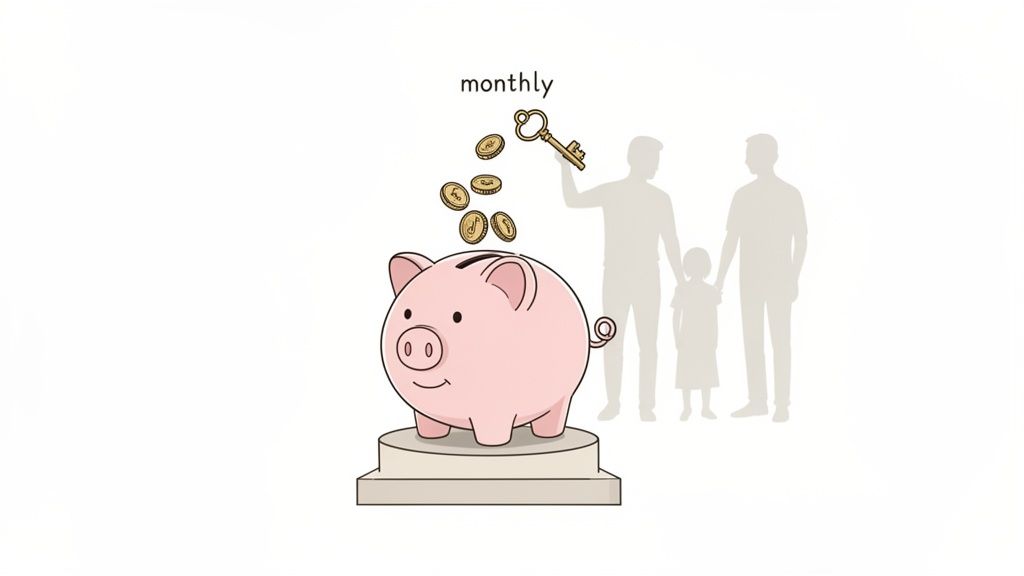
Think of whole of life insurance as a financial promise to your family that never expires. It's a bit like a locked savings box; you pop a small, manageable amount in each month, and your family gets the key to the full amount right when they need it the most.
It’s designed for complete certainty.
What really sets this cover apart is its guaranteed payout. While other policies, like term insurance, can expire if you outlive them, a whole of life plan is for good. Keep up with the payments, and the payout is assured.
To put its core features into a simple format, here’s a quick overview.
| Feature | How It Works |
|---|---|
| Policy Duration | Lasts for your entire lifetime. |
| Payout Guarantee | The payout is 100% guaranteed as long as premiums are paid. |
| Premium Type | Usually fixed, meaning the monthly cost doesn't change. |
| Payout Sum | A pre-agreed, fixed lump sum. |
| Primary Use | Ideal for covering known future costs like funerals or inheritance tax. |
This table neatly sums up why people choose this specific type of cover—it's predictable and permanent.
Here in the UK, whole of life insurance is typically used to solve two very specific financial headaches your family could face after you’re gone. It’s less about replacing a lost salary and more about creating a dedicated pot of money for predictable, often significant, expenses.
The two main jobs for a whole of life policy are:
This strategic use for Inheritance Tax is one of the main reasons people explore this type of cover. By writing the policy 'in trust', the payout usually sits outside of your estate. This means it can be paid to your beneficiaries quickly and without being liable for IHT itself—a very smart move.
This core idea—a guaranteed sum for a specific, future need—is the key to understanding how whole of life insurance works. It's not just life insurance; it’s a long-term financial planning tool built for absolute peace of mind.
Think of a whole of life insurance policy as a straightforward, lifelong promise. You agree to pay a set amount each month, and in return, the insurance company guarantees it will pay out a specific cash lump sum to your family when you die. The key thing to remember is that this payout is guaranteed, no matter when that happens.
Your monthly payment is called the premium, and it’s usually fixed for life. This is a huge plus because it means the price you pay on day one is the same price you’ll be paying decades from now. You get complete predictability, so there are no nasty shocks down the line if your health changes or you get older.
The money your family eventually receives is known as the guaranteed sum assured. This is a fixed, tax-free cash amount that’s locked in from the moment you take out the policy. Whether you pass away five years or fifty years later, that’s the exact amount your loved ones are guaranteed to get, which brings real peace of mind.
When you start looking at quotes, you’ll probably see two main flavours of whole of life cover here in the UK. Getting your head around the difference is crucial for picking the one that aligns with your long-term plans.
For most people, balanced cover is the way to go. You can set it up, forget about it, and have total confidence that the cost won't change and the payout your family receives is set in stone.
This kind of permanent insurance really shines for people planning for later life. Unlike term policies that expire, whole of life cover is designed to pay out no matter what, making it a reliable tool for definite costs, like paying for a funeral.
Of course, some people have concerns. Research shows that while 78% of over-50s worry about getting value for money, a solid 62% still see the clear benefit. They really value knowing that a fixed sum—often between £2,000 and £20,000—is waiting to cover final expenses, which now average around £4,000 to £5,000. You can find out more about these over-50s insurance trends from the FCA.
Ultimately, the whole system is built for simplicity and certainty. Your regular payments create a lifelong safety net that, unlike temporary cover, is guaranteed to be there when it’s needed. It's about leaving behind a helpful financial gift instead of a burden.
Knowing how a policy works is one thing, but figuring out if it actually fits your life is the real test. Whole of life insurance isn't a catch-all solution; think of it more as a specialised tool, designed to solve very specific, long-term financial problems for you and your family.
So, let's move beyond the theory and look at where this cover really comes into its own. It tends to shine brightest in a couple of key scenarios, offering absolute certainty when it’s needed most. By exploring these situations, you can get a much clearer picture of whether your goals match what this unique insurance is built for.
One of the most common and powerful uses for a whole of life policy is in Inheritance Tax (IHT) planning. If you suspect the total value of your estate—that’s everything from your property to your savings and investments—is likely to go over the government's threshold, your beneficiaries could be hit with a hefty tax bill.
As it stands, IHT is charged at a staggering 40% on any part of your estate that’s above the tax-free allowance. This can put families in a really tough spot, sometimes forcing them to sell beloved assets like the family home just to pay the bill from HMRC.
This is exactly where a whole of life policy, when written ‘in trust’, becomes an incredibly smart solution.
By placing your policy in a trust, the eventual payout is kept separate from the rest of your estate. This simple step means it isn't counted for IHT purposes and can be paid directly to your beneficiaries, often bypassing the long and drawn-out probate process. Essentially, you're leaving behind a dedicated fund for your family to settle the tax bill, protecting their full inheritance and preserving your legacy.
The other main reason people opt for this cover is deeply personal: they simply want to make sure their loved ones aren't left with the financial headache of a funeral. It’s a thoughtful and practical way to plan ahead for a cost that is, after all, inevitable.
Here’s a situation many people can relate to:
This approach is particularly common among those who want certainty in their later years. While most whole of life policies require medical underwriting, there are specialised plans out there. To learn more, you might find our guide on over 50s life insurance helpful, as these policies often come with guaranteed acceptance.
In the end, whether whole of life insurance is the right move boils down to your personal circumstances and what kind of legacy you want to leave. If your key goals are to shield your estate from tax or to ensure final expenses are covered without any fuss, it could be a perfect fit.
No financial product is a perfect one-size-fits-all solution, and whole of life insurance is certainly no different. To figure out if it's the right move for you and your family, it’s vital to look at both sides of the coin. This isn't just about the benefits; it's about understanding the commitments involved, too.

By weighing up the good against the not-so-good, you can make a truly informed choice, giving you confidence in your financial plans for the years ahead.
The biggest selling point of this type of policy boils down to one simple word: certainty. It’s designed to take the "what ifs" out of the equation, creating a solid foundation for your estate and giving you lasting peace of mind.
Here are the main upsides:
In essence, you're paying for absolute predictability. You know exactly what it will cost each month and precisely what your loved ones will receive. This removes all the guesswork and provides a rock-solid financial safety net.
Of course, it’s not all one-way traffic. There are some important considerations on the other side of the scale, mainly linked to the cost and the sheer length of the commitment, which could span several decades.
Here’s what you need to think about:
Understanding these trade-offs is crucial. While term cover is built for temporary needs like a mortgage, whole of life is a permanent solution for guaranteed costs. If you’re looking for cover that only lasts for a specific period, you can explore the key differences in our article explaining term life insurance.
Ultimately, whether this is the right policy for you comes down to your personal circumstances and what you want to achieve.
For someone who needs to leave a definite sum to settle an inheritance tax bill or cover guaranteed funeral costs, the certainty of a whole of life policy can be priceless. The higher cost is simply the price you pay for a guaranteed result.
However, if your main goal is simply to protect your family from the financial fallout of your death while the kids are young or the mortgage is outstanding, a more affordable term policy is likely a much better fit. The key is to match the product to your specific needs, making sure the benefits you value most are the ones you're paying for.
The cost of a whole of life policy isn't pulled out of thin air. It’s a very specific calculation based on you as an individual. Insurers need to work out the level of risk they’re taking on, and that calculation directly shapes the monthly premium you'll pay.
Getting your head around these factors is the first step to finding the right cover without overpaying. This whole process of assessing your risk profile is known in the industry as underwriting. It’s simply the insurer’s way of making sure the price is fair for everyone involved.
So, what are insurers really looking at when you apply? In short, they’re building a picture of your life expectancy. A handful of key details will have the biggest impact on their calculations.
Being completely honest and upfront during your application is crucial. It ensures the quote you get is accurate and, more importantly, that your policy will be valid when it's needed most.
Ready to get a quote? The path to getting covered is pretty straightforward. It all starts with an application form and then moves into the underwriting stage, which sometimes involves a bit more than just paperwork.
Here’s what the journey typically looks like:
It's important to remember that this process is designed to be fair. It ensures your premium accurately reflects your individual circumstances, giving you peace of mind that your cover is secure.
You can also take comfort in the stability of the UK insurance industry. Regulatory stress tests from the Bank of England consistently show that the sector is strong enough to withstand even severe economic shocks. This means you can be confident that your policy is a dependable, long-term financial planning tool. You can read more about these findings in the Bank of England's 2025 results report.
So, we've walked through how whole of life insurance works, who it’s really for, and what it might cost. But I find this is usually the point where the practical, "what if" questions start to pop up. This final section is all about tackling those common queries head-on with clear, straightforward answers.
The aim here is to clear up any lingering confusion you might have. Think of it as a final chat to make sure you feel completely comfortable and informed before taking any next steps. We'll get into the nitty-gritty of managing a policy, see how it stacks up against similar products, and unpack crucial details like writing a policy in trust.
This is easily one of the most common questions I hear, and for the vast majority of UK policies, the answer is a simple one: no, you can't cash it in.
A standard whole of life policy is a pure protection product. Its one and only job is to pay out a guaranteed, tax-free sum to your loved ones when you pass away. It doesn't build up a 'cash-in value' or 'surrender value' that you can dip into during your lifetime.
It helps to think of it more like your car insurance than a savings account. You pay the premiums for the peace of mind that the protection is in place, not to build a pot of money for yourself. While there are some very complex investment-linked policies out there that do have a cash value, they are a completely different beast and usually far more expensive than the standard cover we're discussing here.
This is a critical point to get your head around because the consequences are quite stark. If you stop paying the monthly premiums on your whole of life policy, the cover will lapse. The policy simply ends.
This means two things will happen:
This is precisely why it’s vital to choose a premium you're confident you can afford for the long haul. The long-term affordability is every bit as important as the amount of cover you choose today. It’s something any good adviser will stress when helping you set up a lifelong plan like this.
This isn't really a question of which is "better," but which is the right tool for the job you have in mind. Whole of life insurance and over 50s plans look similar on the surface, but they're built for very different purposes.
An over 50s plan offers guaranteed acceptance to UK residents between 50 and 85, with no medical questions asked. This makes it a great, accessible way to secure a smaller lump sum—typically between £1,000 and £20,000—specifically to help cover funeral costs.
A whole of life policy, on the other hand, is medically underwritten. You’ll have to answer questions about your health and lifestyle. Because the insurer gets a clear picture of the risk they're taking on, they can offer a much larger amount of cover, often running into hundreds of thousands of pounds. This makes it the go-to choice for bigger financial planning goals, like covering a hefty Inheritance Tax (IHT) bill.
Key Takeaway: You'd choose an over 50s plan for guaranteed acceptance and to ring-fence money for a funeral. You’d choose a medically underwritten whole of life policy for large-scale estate planning and tackling Inheritance Tax.
Writing your policy 'in trust' sounds complicated, but it's a simple and incredibly powerful bit of financial planning. It can make a huge difference to the legacy you leave behind.
In plain English, putting a policy in a trust is like placing the payout money into a secure legal box. You appoint people you trust (your 'trustees') to look after the box and leave clear instructions on who should get the money (your 'beneficiaries') after you're gone.
This one straightforward step achieves two massive goals:
Most insurers provide standard trust forms and plenty of guidance to make this process as painless as possible.
Many insurers will give you the option to add critical illness cover to your whole of life policy. Doing this creates a more comprehensive plan that can protect you during your lifetime, as well as your family after you’re gone.
If you add this benefit, the policy will pay out on the first event—either on your death or if you’re diagnosed with a serious condition specified in the policy. It's important to realise that it's usually a one-and-done payout. If you claim for a critical illness, the life cover part of the policy then ends.
This can provide a vital financial safety net if you become seriously ill and can't work, helping to cover medical bills, home adaptations, or just your day-to-day living expenses. You can find out more by reading our detailed guide on life insurance with critical illness cover.
Ultimately, getting to grips with these details helps demystify whole of life cover. It’s not just an insurance policy; it's a strategic tool for making sure your financial wishes are carried out exactly as you planned, giving lasting security and certainty to the people who matter most.
At Life Cover Plans, we make it easy to compare quotes from the UK's leading insurers, helping you find the right protection at the right price. Start your free, no-obligation comparison today and take the first step towards securing your family's future. Click below to get your free quote now!
Get My Free Quote >>