Mortgage life insurance is a specific type of cover designed to do one job really well: pay off your outstanding mortgage if you pass away before it's cleared. It’s essentially a financial safety net for your family, ensuring the biggest debt you have is taken care of.
The whole point is to give your loved ones the peace of mind that they can keep their home, without the pressure of finding the money for monthly mortgage payments.
Taking out a mortgage is a huge milestone, but it's also a massive financial commitment, often stretching for decades. Mortgage life insurance is designed to run alongside it, specifically to cover that debt.
The most common form is called decreasing term insurance, and the name gives a big clue as to how it operates.
Think of your mortgage balance and your insurance cover as being on a see-saw. At the start, your mortgage debt is high, so the potential insurance payout is also at its highest. As you make your monthly repayments over 25 or 30 years, your mortgage balance goes down. At the same time, the potential payout from the the insurance policy also reduces, roughly tracking the remaining debt.
The goal is beautifully simple. If you were to die during the term, the policy should pay out just enough for your family to clear the mortgage. This direct link to your mortgage is what makes it different from other life insurance policies.
To help you get a quick overview, here are the core components of a typical policy.
| Feature | Description |
|---|---|
| Payout Type | Decreasing. The potential lump sum payout reduces over the policy's term. |
| Primary Goal | To pay off a repayment mortgage, securing the family home for loved ones. |
| Premiums | Usually fixed. You pay the same amount each month for the entire term. |
| Policy Term | A set period, typically matched to the length of your mortgage (e.g., 25 years). |
| Beneficiaries | The payout goes to your family, not the lender, giving them control. |
This table shows how the policy is built specifically for one purpose: clearing your mortgage debt efficiently.
This type of cover is built around a few core ideas that make it a perfect fit for a standard repayment mortgage. Let's break them down:
It's really important to understand this: the payout from a mortgage life insurance policy is paid to your family or chosen beneficiaries, not directly to your mortgage lender. They receive a tax-free lump sum and can then decide to use it to pay off the mortgage, giving them breathing room and control at a tough time.
This structure makes it a very cost-effective way to protect a specific, large debt. Because the insurer's potential payout gets smaller over time, the premiums for decreasing term cover are often much cheaper than for other types of life insurance where the payout amount stays the same. It's a precise tool for a particular job—keeping a roof over your family's head.

Forget the jargon and policy fine print for a moment. At its heart, mortgage life insurance is about one thing: keeping your family in their home if the worst should happen. It’s a financial safety net designed to catch your biggest single expense – the mortgage – so your loved ones don’t have to.
If you were no longer around to pay your share, your family would be facing an enormous financial burden at an incredibly difficult time. This cover is there to step in, pay off the outstanding mortgage, and remove that worry completely.
Let's make this real. Picture a couple, Sarah and Tom, who have just taken out a £250,000 mortgage to buy their first family home, with a term of 25 years.
They decide to get a decreasing term life insurance policy to match it. Here’s how it works in practice:
See how they move in lockstep? The policy is specifically designed to shadow the mortgage balance, ensuring the right amount of cover is always there without you paying for more than you need.
Honestly, the biggest benefit isn't just the money. It's the quiet confidence you get from day one, knowing you’ve protected your family's future. It means they could grieve and adjust to a new life without the terrifying prospect of having to sell the house or struggle with unmanageable repayments.
This is more crucial than ever. With mortgage payments now making up around 23% of the average UK household's income, it's a huge financial commitment. Getting cover sorted when you first take out your mortgage is a smart move. You're typically younger and healthier, which usually means locking in much cheaper monthly premiums for the entire term.
Think of it like this: by covering your mortgage, you're putting a protective bubble around your family's biggest asset. The policy stands guard, making sure the home remains a source of comfort and memories, not a source of debt and anxiety.
When you strip it all back, mortgage life insurance simply ensures that if tragedy strikes, your house can remain a home. It's a powerful and responsible step towards leaving a legacy of security, allowing your family to stay right where they belong. That’s what it's really all about.
Figuring out that you need life cover is the easy part. The real head-scratcher for many people is deciding which type of policy to get. They don't all work the same way, and the right one for you comes down to what you're trying to protect.
Think of it like choosing a tool from a toolbox. You wouldn't use a sledgehammer to hang a picture frame, would you? Life insurance is no different. Each policy is designed for a specific job, and matching the right one to your family’s financial goals is key.
Let's walk through the main options so you can see exactly how they stack up.
We've already touched on this one, but it's worth repeating: decreasing term insurance is the purpose-built tool for protecting a standard repayment mortgage. Its defining feature is a payout that shrinks over time, specifically designed to track your mortgage balance as you pay it down.
This clever design makes it incredibly cost-effective. Why? Because the insurer's potential payout—their risk—is constantly reducing, just like your loan. Its job is simple and precise: make sure the mortgage is cleared if you're not around to finish paying it.
In contrast, level term insurance does exactly what it says on the tin. The payout amount is fixed for a set number of years. If you arrange a £200,000 policy over 25 years, it will pay out that full £200,000 whether a claim happens in the first year or the last.
This steady, predictable cover makes it a better fit for different needs:
Because the payout never drops, level term cover is naturally more expensive than a decreasing policy for the same initial sum. To get a better handle on this, you can learn more about term life insurance and see how it fits into wider financial planning.
It’s all about creating a financial shield that keeps your home safe for your family, no matter what.
Now for something completely different. Unlike term policies which run out, a whole of life policy lasts for your entire life. As long as you keep paying the premiums, it guarantees a payout when you pass away.
This certainty makes it a specialist product, typically used for:
Because a payout is guaranteed, whole of life cover is the most expensive option of the three.
To help you see the differences at a glance, here’s a simple table breaking down the main policy types.
| Policy Type | Payout Amount | Typical Cost | Best For |
|---|---|---|---|
| Decreasing Term | Reduces over time, tracking a debt | Low | Clearing a repayment mortgage |
| Level Term | Stays the same for the policy term | Medium | Income replacement, interest-only mortgages, family protection |
| Whole Of Life | Guaranteed payout upon death | High | Inheritance tax planning, funeral costs, leaving a legacy |
As you can see, there’s no single "best" policy—only the one that’s best for your specific circumstances.
If you’re a couple, you’ve got one more decision to make: two separate policies, or one policy to cover you both?
A joint policy covers two people but only pays out once—on the 'first death'. The policy then ends, leaving the surviving partner with no life cover. While it’s often a little cheaper, this can create a serious protection gap later on.
Two single policies, on the other hand, provide independent cover. If one person passes away, their policy pays out, but the surviving partner’s policy continues. This means there’s potential for two payouts, offering much more robust financial security for your family's future.
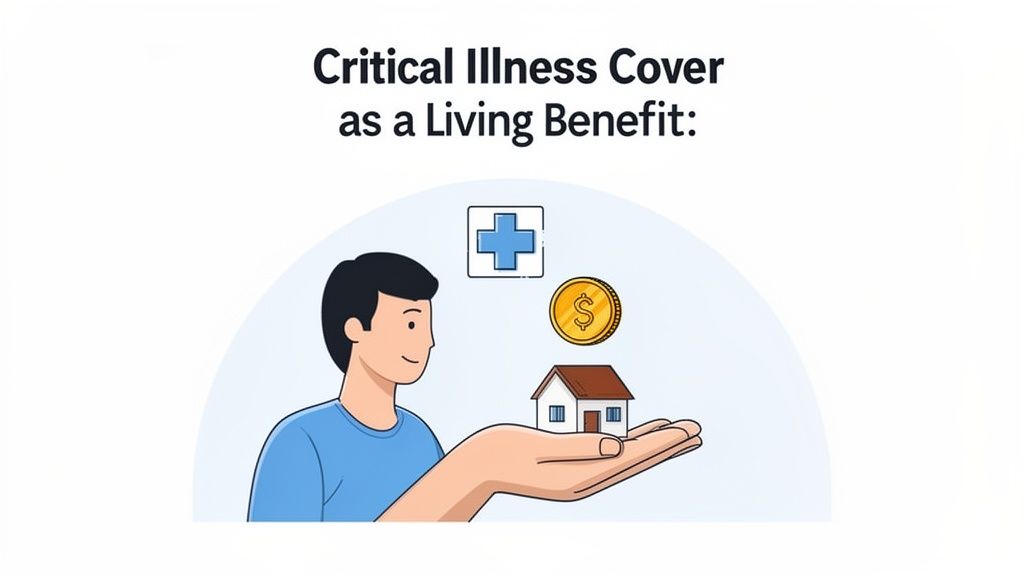
A standard mortgage life policy is an excellent safeguard, but it has one key limitation: it only pays out when you die. This leaves a massive and often unconsidered gap in your financial protection. What would happen if you were diagnosed with a serious illness and couldn't work?
Your mortgage repayments won't pause while you recover, but your income almost certainly will. This is exactly where critical illness cover steps in, acting as a vital extension to your life insurance.
It’s sometimes called a ‘living benefit’ because it’s designed to pay out a tax-free lump sum if you’re diagnosed with a specific, life-altering condition covered by your policy. For many homeowners, this isn't just a nice-to-have; it's a financial lifeline.
Here’s a simple way to look at it: life insurance protects your family’s finances if you’re no longer around. Critical illness cover protects your finances if you are still around but can't earn a living. A sudden diagnosis like cancer, a heart attack, or a stroke could instantly halt your ability to work for months, or even permanently.
The financial fallout from something like that can be devastating, going far beyond just covering the mortgage.
A payout from a critical illness policy provides the financial breathing space to manage these new challenges without wiping out your savings or falling into debt. You could use the money to pay off the mortgage entirely, fund private treatment, or simply cover your bills so you can focus on getting better.
It's easy to think "it won't happen to me," but the risk of becoming seriously ill during your mortgage term is higher than most people imagine. In fact, a recent analysis showed that as many as one in three UK mortgage holders will face a serious critical illness before making their final mortgage payment. With cancer, heart attacks, and strokes making up the bulk of claims, this highlights a genuine vulnerability for homeowners. Find out more about the risk homeowners face in the UK and see why this protection is so vital.
Adding critical illness cover to your mortgage life insurance transforms your policy from a simple debt-clearance tool into a comprehensive financial shield. It protects your family from two of life’s biggest fears: the financial impact of death and the financial strain of serious illness.
This combined approach creates a much more robust safety net. You can choose to have the critical illness element 'accelerated', which means the policy pays out once (either on diagnosis or death), or as an additional benefit. While adding this cover will increase your monthly premium, the peace of mind it offers is often priceless. If you're thinking about it, it's a good idea to compare critical illness life insurance quotes to see what the costs look like and find a policy that fits your budget. Ultimately, it’s about building a plan that truly secures your home, no matter what life throws at you.
When you apply for mortgage life insurance, the monthly premium you're quoted isn't just a number plucked from thin air. Insurers go through a detailed risk assessment for every single applicant – a process they call underwriting.
Think of it like this: they're building a complete picture of you to figure out how likely it is they'll have to pay out a claim. The less "risky" you appear in their eyes, the less you’ll pay each month. Knowing what they look at is key, as it explains why quotes can differ so wildly and gives you a bit more control over the final price.
These two factors are the absolute bedrock of any life insurance calculation. It's a simple matter of statistics: the younger and healthier you are, the lower the probability of you passing away while the policy is active.
This is why a 28-year-old in great shape will nearly always get a cheaper quote than a 48-year-old managing a long-term health condition. During the application, you'll face a barrage of health questions. It's vital to be completely upfront here. They'll want to know about:
Don't be surprised if, for a larger mortgage, the insurer asks for a mini-medical or a report from your GP. They just want to get the clearest possible picture of your health.
Your day-to-day habits have a huge bearing on your long-term health, and insurers pay very close attention to them. The biggest one by a country mile? Smoking.
If you're a smoker or have only recently quit, expect your premiums to be significantly higher. We're often talking double the price of a non-smoker's policy. This is purely because smoking is directly linked to a much higher risk of life-threatening illnesses like cancer and heart disease.
It doesn't stop there. They'll also ask about your alcohol intake and whether you're into any adrenaline-fuelled hobbies. Think rock climbing, scuba diving, or anything else that carries a higher-than-average risk.
Your occupation can also nudge your premiums up or down. Someone working in an office faces far fewer daily risks than, say, a scaffolder working at height or a deep-sea diver. The insurer is simply weighing up the potential for a work-related accident.
The UK's life insurance market is massive, which shows just how many homeowners are taking these steps to protect their families. To give you an idea, the Financial Conduct Authority (FCA) reported that in just one recent quarter, 234,783 new life insurance policies were sold, bringing in £111.43 million in new premiums. This just goes to show how central these underwriting factors are in a really busy market. You can read more about the FCA's life insurance sales data if you want to dig into the numbers.
Finally, the nuts and bolts of the policy you actually choose will directly impact the cost. These are the levers you can pull to make sure the cover fits your budget.
Now that we’ve broken down what mortgage life insurance is, let's talk about turning that knowledge into action. Getting the right policy doesn't need to be a headache. Following a clear, logical path can help you find affordable cover that actually lets you sleep at night.
The whole journey really starts with getting your facts straight. You need to know precisely how much cover you need and for how long. This simple step makes sure you’re not overpaying for protection you don't need or, far worse, leaving your family with a shortfall.
Before you even think about looking for quotes, a little bit of prep work will make the entire process a whole lot smoother. It's like gathering your ingredients before you start cooking – it just makes everything easier.
Here's a straightforward plan to get you started:
These first few steps essentially create the blueprint for the exact policy you should be looking for.
Once you've got a clear picture of what you need, the single most important thing you can do is compare quotes from different insurers. The prices for identical cover can vary wildly from one provider to another. Simply taking the first offer you see could mean you end up overpaying for years to come.
This is where a comparison service really proves its worth. Instead of ringing up insurers one by one, you get to see a whole range of options all in one place. Using a free service connects you with specialists who know the market inside out and can track down deals from leading providers like Aviva and Legal & General, saving you both time and money. For those thinking further ahead, it might also be useful to explore options like those we cover in our guide on over 50s life cover.
Think of it this way: You wouldn't buy a car without checking the prices at a few different dealerships. Your family's financial security is far more important and deserves at least the same level of care.
An expert can also walk you through the application, making sure the policy is a perfect fit for your situation. That guidance takes away the guesswork and hassle, making the whole process of protecting your family’s home feel simple and straightforward.
Even when you've got the basics down, it's completely normal to have a few more questions rattling around. Let's tackle some of the most common ones that crop up for homeowners, so you can feel clear and confident about protecting your family and your home.
We'll cut through the jargon and get straight to the practical answers you need.
In a word, no. You are not legally required to have mortgage life insurance to get a mortgage in the UK. However, just because it's not mandatory doesn't mean it's not essential.
Most lenders will strongly encourage you to get life cover. It makes sense for them, of course, as it secures their loan, but more importantly, it protects your family from a huge financial shock. Think of it less as a legal hurdle and more as a core part of responsible homeownership.
This is a great question. Your mortgage life insurance policy is linked to you, not your house or your specific mortgage deal. So, if you move and take on a bigger mortgage, or remortgage for a longer term, your old policy probably won't be enough to cover the new debt.
It's crucial to review your cover whenever your mortgage changes. You might need to increase the amount on your current plan or, in some cases, take out a completely new policy. It’s a simple step, but one you can't afford to miss.
A common mistake is assuming your cover just adapts on its own. It doesn't. Always give your insurer or broker a call when your mortgage changes to make sure your family isn't left underinsured
Yes, it’s often still possible to get cover even if you have a pre-existing medical condition. The single most important thing is to be upfront and honest about your health from the very beginning.
The insurer will likely want more information, maybe by getting a report from your GP, to understand your situation fully. Depending on the condition, you might find your premiums are a bit higher, or they might exclude claims related to that specific illness. This is where a specialist broker really earns their stripes—they know which insurers are more understanding for different health issues and can guide you to the right place.
Getting your head around this is vital for your long-term budget.
For a long-term commitment like protecting your home, most people find the stability and peace of mind of guaranteed premiums is the smarter choice.
Ready to put that protection in place? Life Cover Plans makes it simple to compare quotes from the UK's leading insurers, helping you find the right cover without the hassle. Click below to get your free, no-obligation quote today and take the first step towards securing your family's future.
Get My Free Quote >>