It’s easy to get confused between critical illness cover and life insurance, but the core difference is actually quite simple. Life insurance pays out a tax-free lump sum to your family after you die, whereas critical illness cover pays a lump sum directly to you if you’re diagnosed with a specific serious illness.
Think of it this way: one is designed to protect your family’s financial future without you, while the other is there to protect your finances during a life-changing health crisis.
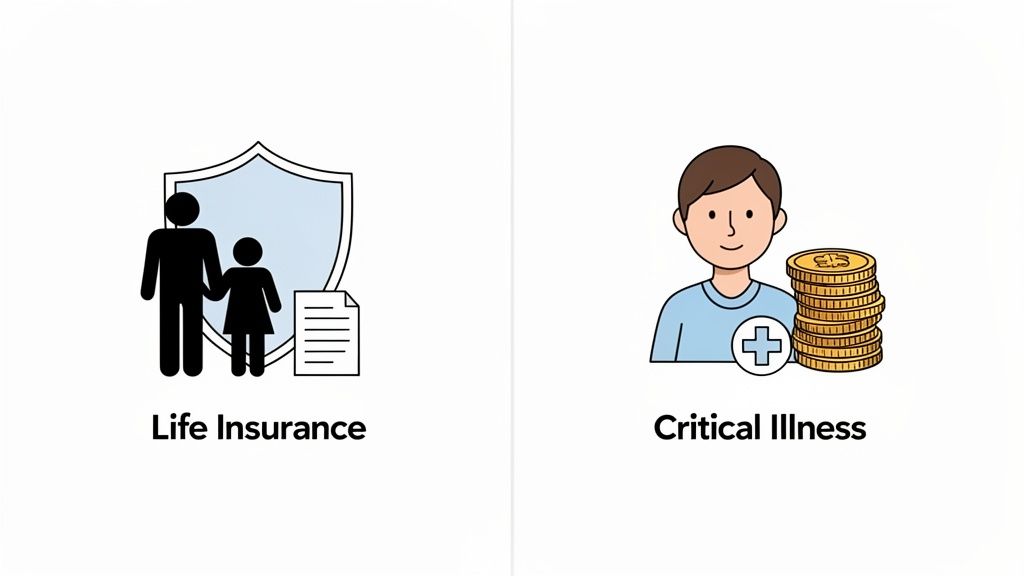
To make the right choice, you need to understand what each policy is built for. Life insurance is fundamentally a financial safety net for your dependents. It ensures they can cope financially if your income is suddenly gone, covering major long-term costs like the mortgage, day-to-day living expenses, and funeral arrangements.
Critical illness cover, however, is what we call a ‘living benefit’. It’s there to provide immediate financial breathing room while you’re alive, helping you manage the financial shock of a severe illness like cancer, a heart attack, or a stroke. The money is paid to you, and you can use it for whatever you need most – perhaps to fund private medical treatment, adapt your home, or simply replace lost income so you can focus entirely on getting better. You can find out more by reading our guide to how critical illness cover works.
The event that triggers a payout is what really sets these two policies apart. For life insurance, the trigger is clear-cut: the policyholder’s death. Critical illness claims, on the other hand, are based on a medical diagnosis that must match the exact definition laid out in your policy. You also usually need to survive for a short period after diagnosis, typically 10 to 14 days, for the claim to be valid.
This difference is clear in the industry-wide claims data. In 2023, UK insurers paid out on 91.6% of critical illness claims, totalling £1.27 billion. In comparison, life insurance had a higher payout rate of 96.9%, with £3.90 billion paid out. The average critical illness payout was £68,354 – a sum that provides crucial support at an incredibly difficult time.
To put it all into perspective, here's a quick side-by-side look at the main distinctions between the two types of cover.
| Feature | Critical Illness Cover | Life Insurance |
|---|---|---|
| Payout Trigger | Diagnosis of a specified serious illness | Upon the policyholder's death |
| Primary Purpose | Financial support during your recovery | Financial security for your dependants |
| Who Gets Paid | The policyholder (you) | Your nominated beneficiaries |
| When It Pays Out | While you are still alive | After you have passed away |
Ultimately, the choice isn't necessarily about picking one over the other. For many people, a combination of both provides the most complete financial protection for themselves and their loved ones.
The best way to get your head around the difference between critical illness cover and life insurance is to look at how the money is actually used. Think of it this way: a life insurance payout acts as a financial backstop for your loved ones after you’re gone, whereas a critical illness payment is a lifeline for you while you're still here, recovering.
Each policy is built to tackle a completely different set of financial pressures. Let's dig into the practical uses for each payout to see why one can't really do the job of the other.
When you take out life insurance, you’re essentially planning for your family's long-term future. The tax-free lump sum is there to shield them from financial hardship and answer the crucial question: "How will my family cope financially without me?"
The money is most often used to handle the big, daunting financial commitments that would otherwise fall squarely on their shoulders.
Here’s what a life insurance payout typically covers:
At its core, a life insurance payout is a forward-thinking tool. It’s all about making sure the plans you had for your family’s future can still happen, even when you’re not there to see them through.
Critical illness cover works on a completely different timeline. It pays a tax-free lump sum directly to you as soon as you're diagnosed with a serious condition specified in your policy. This is why it’s often called a ‘living benefit’—it’s designed to help you right here, right now.
The real strength of this payout is its flexibility. You can use it for whatever you need most to get through your treatment and recovery.
Practical uses for a critical illness payout include:
The core difference is purpose and timing. Life insurance is designed to secure your family's legacy after you're gone. Critical illness cover is there to protect your current lifestyle and financial stability during a health crisis, giving you the resources to focus on recovery.
When you see their distinct roles, it becomes clear how these two types of cover can work together. They create a much stronger financial safety net, protecting you through life's biggest challenges and providing for your loved ones afterwards.
When you start to dig into the nuts and bolts of critical illness cover versus life insurance, the differences really come into focus. While both provide a much-needed financial safety net, they work in fundamentally different ways, pay out for different reasons, and come with very different price tags. Getting your head around these details is the key to choosing the right protection for you and your family.
The biggest difference by far is the payout trigger. For life insurance, the condition is black and white: the policyholder passes away. A death certificate is usually the main piece of paperwork needed to get the ball rolling, which makes the whole claims process relatively straightforward. This simplicity is a core feature, offering a clear path to financial support for your loved ones when they need it most.
Critical illness cover, on the other hand, operates in a much greyer area. A payout isn't just triggered by a diagnosis, but by a diagnosis that meets the insurer's very specific medical definition for a covered condition.
A standard life insurance policy, especially a term life insurance plan, is designed to cover death from almost any cause. Whether it's an illness, an accident, or natural causes, the policy will pay out. There are very few exclusions, with the main one typically being suicide within the first 12-24 months of the policy.
In sharp contrast, a critical illness policy only pays out for conditions that are explicitly named in the policy document. This isn't a universal list; it can vary quite a bit between insurers, although you'll almost always find the big ones like cancer, heart attack, and stroke included.
But it’s not just about the diagnosis—the severity of the illness is crucial. A diagnosis alone might not be enough to secure a payout. For instance:
This level of detail is how insurers manage their risk, but it means you absolutely have to understand what your policy covers before you sign on the dotted line.
The core difference is this: life insurance is triggered by the fact of death, while critical illness cover is triggered by the specific medical facts of a diagnosis. This single distinction drives almost all the other differences in claims, underwriting, and cost.
To help clarify these distinctions, let's look at a side-by-side comparison of the key policy features.
| Comparison Point | Critical Illness Cover | Life Insurance |
|---|---|---|
| Payout Trigger | Diagnosis of a specific, defined serious illness during the policy term. | Death of the policyholder during the policy term. |
| Common Exclusions | Pre-existing conditions, illnesses not meeting severity definitions, self-inflicted injuries. | Suicide within the first 1-2 years, death from high-risk hobbies not disclosed at application. |
| Typical Cost Factors | Higher premiums due to higher probability of a claim. Age, health, lifestyle, and scope of cover are key. | Lower premiums for the same cover amount. Age, health, lifestyle, and policy term are key. |
| Claims Process Complexity | More complex. Requires detailed medical evidence to prove the condition meets the policy's definition. | Simpler and more straightforward. Usually requires a death certificate and claim form. |
This table shows just how different the two policies are in practice, from the initial trigger to the final payout.
The underwriting process—the risk assessment insurers carry out before offering you cover—is pretty thorough for both. They’ll want to know about your age, health, lifestyle (especially if you smoke), and your family's medical history to calculate your premium.
The claims process, however, really highlights the divide. A life insurance claim is generally quick and simple, and payout rates are consistently very high. With critical illness claims, the medical complexity means they come under much greater scrutiny.
Insurers need to be certain that the diagnosis lines up exactly with the definition in the policy. This can involve going through detailed medical records and reports from specialists, which naturally takes more time. This complexity is borne out in industry statistics. For example, cancer is the top reason for critical illness claims in the UK, making up 58.4% of Aviva's payouts, with an average claim hitting £71,989. While most claims are successful, the Association of British Insurers (ABI) reports that the overall payout rate for critical illness is slightly lower than life insurance's impressive 96.9%. This is partly due to those strict definitions, survival period clauses, and cases of non-disclosure.
The final piece of the puzzle is the cost. Critical illness cover is almost always more expensive than a standalone life insurance policy for the same amount of cover. The reason is simple probability.
Statistically, you are far more likely to be diagnosed with a serious illness during your working life than you are to die. Insurers base their prices on this risk. The higher chance of a claim on a critical illness policy means the premiums have to be higher to cover that potential payout. This pricing difference gets to the heart of the critical illness vs life insurance debate: one protects against a more probable event (illness), while the other protects against an inevitable one that's less likely to happen during the policy term (death).
It’s one thing to understand the technical details of a policy, but it’s another thing entirely to see how it works in the real world. When it comes down to it, the "critical illness vs life insurance" debate is settled by your own circumstances, your financial commitments, and what you’re trying to protect.
Let's step away from the theory and look at a few common situations people find themselves in across the UK. By seeing how different types of cover fit different lives, it becomes much clearer which one might be right for you.
Picture Sarah and Tom. They're in their early 30s, have a young child, and have just bought their first home with a £250,000 mortgage on a 30-year term. Their biggest worry is a simple one: if something happened to one of them, how would the other possibly manage the mortgage and bills on just one salary?
Their number one goal is keeping a roof over their family's head, no matter what.
Recommended Solution: A joint decreasing term life insurance policy with integrated critical illness cover is usually the perfect fit here.
This combination gives them a comprehensive safety net, protecting their home from the financial fallout of either death or a serious health crisis.
Now, let's think about David, a 45-year-old self-employed graphic designer. He doesn't have any children or a partner who depends on him, but his income is everything. If a serious illness stopped him from working for months, his earnings would dry up instantly.
Unlike someone in a traditional job with sick pay, David is on his own. His primary concern is protecting his ability to earn a living.
Recommended Solution: For David, a standalone critical illness policy is absolutely vital.
Because nobody relies on his income after he's gone, a big life insurance policy isn't his top priority. The biggest threat to his financial world is what some call a "living death"—being too ill to work but still having all the usual bills to pay.
A standalone critical illness policy would hand him a tax-free lump sum if he were diagnosed with a covered condition. That money would essentially replace his lost income, letting him pay his rent, cover his costs, and focus on getting better without the pressure of rushing back to his desk.
Finally, meet Chloe, a 38-year-old single mum to two kids, aged 8 and 10. Her sole focus is making sure her children will be looked after financially until they're on their own two feet, even if she's not around to provide for them. She needs a way to replace the income that covers everything from school shoes to university fees.
Her main goal is long-term security for her children if the worst should happen.
Recommended Solution: A level term life insurance policy makes the most sense for Chloe.
While critical illness cover would certainly be helpful, if the budget is tight, life insurance is the policy that directly solves her biggest worry: her children's futures without her.
One of the biggest questions you'll face is whether to buy life insurance and critical illness cover as two separate, standalone policies or bundle them into a single, combined plan. There’s no universal right answer here. The best choice really boils down to your budget, how much protection you feel you need, and your long-term financial goals.
Let’s get straight to it: each path has clear pros and cons you need to weigh up before signing on the dotted line.
A combined life and critical illness policy often looks like the most straightforward and budget-friendly option. It wraps both types of cover into one plan with one monthly payment, which certainly makes life simpler. However, most combined policies operate on a 'one-and-done' basis. This means the policy typically pays out just once. If you're diagnosed with a critical illness and make a claim, the policy pays out and then ends—leaving no life insurance benefit for your loved ones later on.
Standalone policies, on the other hand, offer much greater flexibility and a more robust safety net. You'll have two separate plans—one for life cover, one for critical illness. While this usually means a higher total monthly premium and a bit more admin, it creates two completely independent pots of money. Crucially, a claim on your critical illness policy won't touch your life insurance, which remains in place to protect your family’s future.
The mechanics of how these policies pay out is where the real difference lies. With combined plans, you'll almost always see the term accelerated cover.
Standalone policies automatically give you the benefit of 'additional' cover because they are two entirely separate products from the start.
At its heart, the decision is a trade-off: do you prioritise the lower cost and simplicity of a combined plan, or the flexibility and potential for two separate payouts that standalone policies provide? Your answer will shape how your financial protection works when you need it most.
This decision tree can help you visualise which path might better suit your main financial priorities.

As you can see, your primary goal—whether it's protecting your family, your business, or leaving a legacy—heavily influences whether a combined or standalone approach is the better fit.
Let’s break down the practical differences to make the choice clearer.
| Factor | Combined Policy (Accelerated) | Standalone Policies |
|---|---|---|
| Cost | Generally cheaper, as the insurer is only on the hook for one potential payout. | More expensive, as you're funding two separate policies that could both pay out. |
| Simplicity | Easier to manage with one premium and one set of documents. | Involves managing two different policies, sometimes with two different insurers. |
| Payout | Pays out once, either on diagnosis of a critical illness or on death—whichever comes first. | Can pay out twice: once for a critical illness claim and again upon death. |
| Flexibility | Less flexible. A claim for a serious illness will terminate all cover. | Highly flexible. A critical illness claim has zero impact on your life insurance policy. |
For many young families working with a tight budget, a combined policy is an affordable way to make sure the mortgage is covered against either a critical diagnosis or death. But if you have more disposable income and want to guarantee your family is protected no matter what, the higher cost of standalone policies might be a price worth paying for that complete peace of mind.
Ultimately, it comes down to sitting down and weighing your budget against those 'what if' scenarios to land on the choice that’s right for you.
Getting your head around the differences between critical illness cover and life insurance is one thing, but finding a policy that actually fits your life and your budget is the real challenge. The best way to tackle this is to compare quotes from a good mix of UK insurers. It gives you a proper look at what’s out there, so you’re not just stuck with one provider’s prices.
Using a free comparison service makes this whole process much easier. Rather than slogging through form after form on different websites, you can get a snapshot of the market in one go. It’s a huge time-saver and helps you spot the most competitive deals for what you need.
After you've seen some initial quotes, it’s usually a good idea to chat with an expert. We can put you in touch with FCA-authorised brokers who offer straightforward, impartial advice that's built around you. There's no pressure and no fee. They're simply there to answer your questions, explain the policy jargon, and point out the small print that could make all the difference later on.
A specialist can take a look at your circumstances—whether you need to cover the mortgage, protect your family’s income, or just plan ahead—and recommend the most sensible type of cover. Their experience is brilliant for cutting through the confusion and making sure you’re not overpaying for bells and whistles you don't actually need.
This service is completely free and secure. The real benefit of working with an authorised broker is the confidence you get. You know your decision is based on solid, expert knowledge, not just a bit of guesswork. It makes finding affordable, meaningful protection for your family that much simpler.
Ready to see what your options look like? Comparing quotes is the clearest way to find a policy that genuinely works for you. It puts you in control, letting you balance cost against cover to get the peace of mind you're after.
When you're trying to choose between these two types of cover, a few common questions always seem to pop up. Let's tackle them head-on so you can get a clearer picture of what’s right for you.
Yes, you certainly can. It’s known as standalone critical illness cover, and it's a perfectly valid option for many people. This type of policy is purely focused on providing financial support if you're diagnosed with a serious illness, without any connection to life insurance.
A standalone policy often makes a lot of sense for:
While bundling policies can sometimes save you a bit of money, a standalone plan offers that extra layer of security, ensuring your life cover remains untouched even after an illness claim.
On the whole, yes. A combined policy, often called an 'accelerated' plan, typically comes with a lower monthly premium than buying two separate policies. Insurers price it this way because they only ever have to pay out once—either upon diagnosis of a critical illness or upon your death, whichever comes first.
But this cost saving does come with a pretty big string attached.
The catch with a cheaper combined policy is that it’s a ‘one and done’ deal. Once it pays out for a critical illness, the cover stops. There’s no life insurance left for your family down the line.
It’s a classic case of balancing cost against comprehensive cover. For some, the lower premium is the most important factor. For others, the peace of mind that comes with two independent policies is worth the extra cost.
This is a vital question. Knowing what isn't covered is just as important as knowing what is. While every policy is different, there are a few common reasons a claim might be rejected.
Insurers often won't pay out for:
It's absolutely essential to read the policy's Key Features Document before signing up. That’s where you’ll find the specific definitions and exclusions that apply to your cover.
Feeling clearer about what you need? You can start a free, no-obligation comparison today at Life Cover Plans. Click below to get you're free quote!
Get My Free Quote >>